Types of Network or Cyber Security Attacks
A cyber or network security attack refers to an action performed by a hacker or adversary to steal, modify, or delete data from a computer or network. This tutorial outlines the most common types of cyber and network security attacks.
Social Engineering Attack
In this attack, an adversary interacts with users to obtain information about network resources and security policies. The attacker impersonates an authorized individual during these interactions. Once the necessary information is acquired, it is used to facilitate subsequent attacks.
Examples of social engineering attacks include the following:
- The attacker may call an employee and impersonate the company’s network administrator, convincing the employee to change or disclose a password. If the employee complies, the attacker gains access to the account.
- The attacker may impersonate a user who is unable to log on to the network and contacts a network administrator for assistance. If the administrator provides help, the attacker can gain access to the network.
- The attacker may impersonate a software developer and send an email or notification to a customer, attempting to convince the user to install an update. If the user installs the update from the provided link, a Trojan horse is installed on the system, granting the attacker access.

Phishing Attack
In a phishing attack, a hacker creates a fraudulent website that closely resembles a legitimate one. The attacker then sends an email message designed to deceive the recipient into clicking a link to the fake website. If the victim attempts to log in, the fraudulent site captures the username and password. Then, the hacker uses the captured credentials to access the original website.

Eavesdropping attack
In an eavesdropping attack, a hacker employs network monitoring tools, such as packet sniffers, to capture and analyze network traffic. If the traffic is unencrypted, the hacker reads confidential data, including usernames and passwords.

Spoofing attack
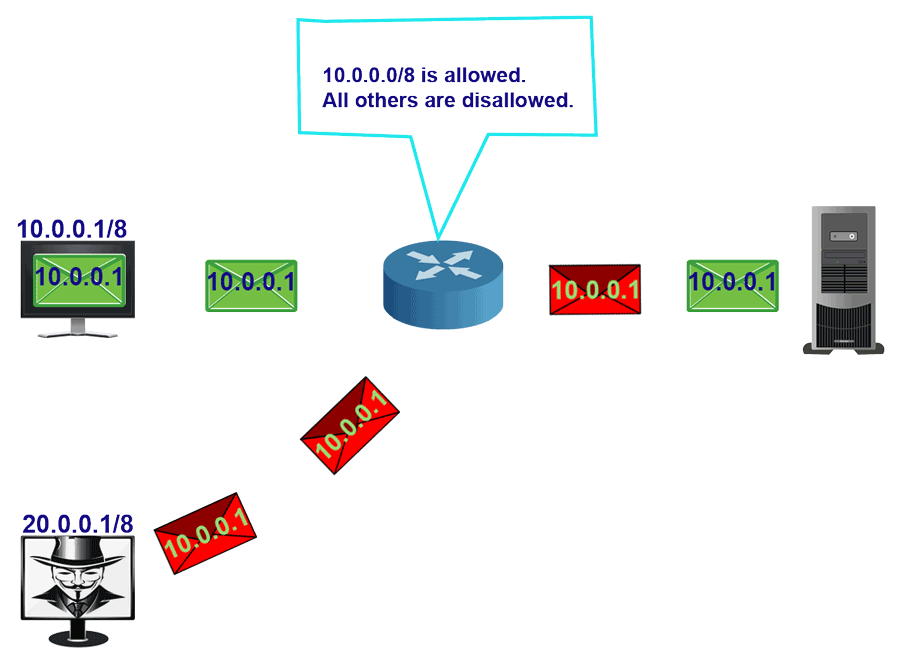
Spoofing attacks primarily aim to bypass access controls on switches, routers, or firewalls. In this attack, the hacker alters the source address of packets before sending them to the target. As a result, the target believes the packets originated from a trusted source. MAC, IP, and Email spoofing are the most common types of spoofing attacks.
MAC spoofing
Switches utilize MAC addresses to filter and forward frames. MAC spoofing occurs when an attacker alters the source MAC address of frames. This technique is primarily used to bypass port security on Ethernet switches and MAC filtering on access points.
IP spoofing
Routers use IP addresses to filter and forward packets. IP spoofing occurs when an attacker alters the source IP address of packets. This method is primarily used to bypass Access Control Lists on routers.
E-mail spoofing
Email spoofing occurs when an attacker alters the source email address of a message. This technique is often used in phishing attacks to make the email appear to originate from a trusted source.
Man-in-the-middle (MITM) attack
In a man-in-the-middle (MITM) attack, the adversary positions himself between two communicating parties and watches all data exchanged between them, who remain unaware that their communication is being intercepted. This allows the attacker to access all confidential information exchanged.

Hijack attack
In a hijacking attack, the adversary takes control of a session between two users by disconnecting one of the parties from the communication. The remaining user believes they are still communicating with the original party and may inadvertently send private information to the attacker.

Denial of Service (DoS) attack
In a Denial-of-Service (DoS) attack, the adversary sends an excessive number of requests to a targeted service, causing it to crash or become unresponsive. For example, overwhelming a web server with requests can prevent it from servicing legitimate users.

Smurf attack
In a Smurf attack, the adversary sends ping requests to multiple computers while modifying the source address so that the packets appear to originate from another system. When these systems respond, they direct their replies to the spoofed source address, overwhelming that system with data.
Buffer overflow
In a buffer overflow attack, the adversary sends more data to a buffer than it can accommodate. This data often contains malicious code that corrupts information or exposes sensitive data. The attacker may use the compromised information to gain administrative access to the system.

Exploit attack
In an exploit attack, the adversary leverages a vulnerability to gain unauthorized access or steal information. A vulnerability is a security flaw or bug in an operating system or software application.
DNS poisoning attack
In a DNS poisoning attack, the adversary performs a zone transfer to obtain a copy of DNS data and map the network. Subsequently, the attacker corrupts DNS records to redirect clients to unauthorized systems.
Physical attack
In a physical attack, the adversary gains unauthorized physical access to a facility and causes damage to equipment or infrastructure. Such attacks are typically directed at known facilities.
ARP poisoning attack
In this method, the attacker alters the Address Resolution Protocol (ARP) cache on a victim’s system, redirecting all network traffic through the attacker’s system and enabling interception of communications.
VLAN hopping attack
In this attack, the adversary double-tags frames for different VLANs or imitates a trunk port to intercept all network traffic. This exploit enables the attacker to gain access to multiple VLANs.
Deauthentication attack
A deauthentication attack targets wireless networks. In this attack, the adversary sends commands to disconnect clients from the network. When clients attempt to reconnect, the attacker captures reauthentication traffic to gain unauthorized access.
Zero-day attack
A zero-day attack occurs when an adversary exploits a vulnerability before the developer becomes aware of the issue and releases a patch.
Password Attack
In a password attack, the adversary attempts to crack passwords to gain unauthorized access. The three primary types of password attacks are dictionary, brute-force, and hybrid attacks.
- In a dictionary attack, the adversary uses a list of potential passwords and a program to systematically attempt each password to gain access to the system.
- In brute-force attacks, adversaries use programs that attempt every possible combination of characters to guess a password.
- In a hybrid attack, the adversary combines dictionary and brute-force methods. This approach uses a word list and appends numbers or characters to words to identify passwords that are not strictly dictionary terms.
Conclusion
This tutorial explained the most common attack types, such as social engineering, phishing, spoofing, man-in-the-middle, and denial-of-service. Understanding these types is essential for network professionals responsible for protecting information systems. It enables better vulnerability recognition and supports proactive security measures.
Author Laxmi Goswami Updated on 2026-01-14