EX294 Exam Objectives and Study Guide
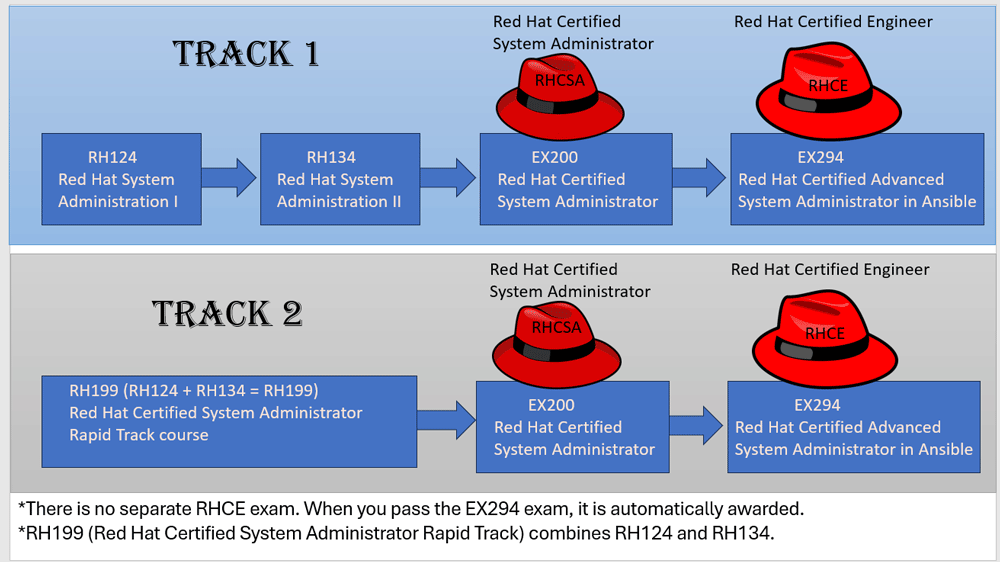
Red Hat Certified Engineer (RHCE) is a performance-based exam organized, managed, and governed by Red Hat. It lets you test and prove the knowledge and skills required to manage Red Hat Linux and its products in various scenarios. Previously, it was a single exam. You had to pass that exam to become an RHCE. In recent years, Red Hat made a major change in its certification programs. It introduced several new exams, updated existing ones, and removed outdated ones. Now, RHCE is only a title. Currently, no official exam is associated with this title. You automatically get it when you pass the EX294 or an equivalent exam. This article lists the EX294 exam objectives and links each objective to a tutorial or series of tutorials that explain the topic in depth with examples.
We continuously update the linked resources to provide the most accurate and valuable study material for the EX294 (RHCE) exam. If a link for any objective is not available right now, we are either preparing a new tutorial or updating an existing one. Please check this page again after a few days.
Prerequisites for the EX294 exam:-
You must have passed the RH199 or RH124 and RH134 exams, and the EX200 exam before enrolling in this exam.
RH124 Exam Objectives and Study Guide
RH134 Exam Objectives and Study Guide
EX200 (RHCSA) Exam Objectives and Study Guide
EX294 Red Hat Certified Advanced System Administrator in Ansible Exam Topics and Study Guide
- Be able to perform all tasks expected of a Red Hat Certified System Administrator
- Understand and use essential tools
- Operate running systems
- Configure local storage
- Create and configure file systems
- Deploy, configure, and maintain systems
- Manage users and groups
- Manage security
- Be able to analyze simple shell scripts
- Understand core components of Ansible
- Inventories
- Modules
- Variables
- Facts
- Loops
- Conditional tasks
- Plays
- Handling task failure
- Playbooks
- Configuration files
- Roles
- Use provided documentation to look up specific information about Ansible modules and commands
- Configure Ansible
- Create and modify ansible.cfg
- Modify ansible-navigator.yml
- Create a static host inventory file
- Create and use static inventories to define groups of hosts
- Configure Ansible managed nodes
- Create and distribute SSH keys to managed nodes
- Configure privilege escalation on managed nodes
- Deploy files to managed nodes
- Run playbooks
- Know how to run playbooks with ansible-navigator and ansible-playbook
- Use ansible-navigator to find new modules in available Ansible Content Collections and use them
- Use ansible-navigator to create inventories and configure the Ansible environment
- Perform basic source control operations using Git
- Clone a Git repository
- Add files to a Git repository
- Be familiar with Visual Studio Code (VS Code) and be able to perform the following tasks from within the editor:
- Create playbooks and push them to a Git repository
- Configure ansible-navigator
- Run playbooks using an Ansible development container
- Create Ansible plays and playbooks
- Know how to work with commonly used Ansible modules
- Use variables to retrieve the results of running a command
- Use conditionals to control play execution
- Configure error handling
- Create playbooks to configure systems to a specified state
- Use roles and Ansible Content Collections
- Create and work with roles
- Install roles and use them in playbooks
- Install Content Collections and use them in playbooks
- Obtain a set of related roles, supplementary modules, and other content from content collections, and use them in a playbook.
- Automate standard RHCSA tasks using Ansible modules that work with:
- Software packages and repositories
- Services
- Firewall rules
- File systems
- Storage devices
- File content
- Archiving
- Task scheduling
- Security
- Users and groups
- Manage content
- Create and use templates to create customized configuration files
- Use Ansible Vault in playbooks to protect sensitive data
Red Hat may change or update any topic listed above at any time without prior notification. We periodically cross-check the above list against Red Hat’s official site and update it as needed. However, if you are planning to take any of the above-listed exams, check the latest exam topics on your end as well on the following official webpages.
https://www.redhat.com/en/services/training/ex294-red-hat-certified-engineer-rhce-exam-red-hat-enterprise-linux
Conclusion
RHCE is a 100% practical-based exams. To practice for it, you need carefully prepared study material. This article provides both. All tutorials and resources linked on this page are prepared by highly qualified professional trainers and are freely available to everyone, without restrictions. You can use it to prepare for your RHCE exam. If you like our effort, you can share it with your friends or anyone else who needs it.
Author Laxmi Goswami Updated on 2026-09-10