Spine-Leaf Architecture in Computer Networking
Spine-leaf architecture is a new layout for network topologies. It replaces traditional three-tier architecture. Traditional architecture struggles to scale modern networks. In addition, it also has several limitations. This tutorial compares it with traditional three-tier architecture and describes its key features and functions.
Spine-leaf architecture categorizes network switches into two layers: spine and leaf. This classification is based purely on the devices the switch connects to. A leaf switch connects only end devices. A spine switch connects only leaf switches. You cannot connect end devices to spine switches. You can connect them only to leaf switches. Leaf switches can connect via spine switches. They cannot have direct connections. The following image shows a spine-leaf architecture.
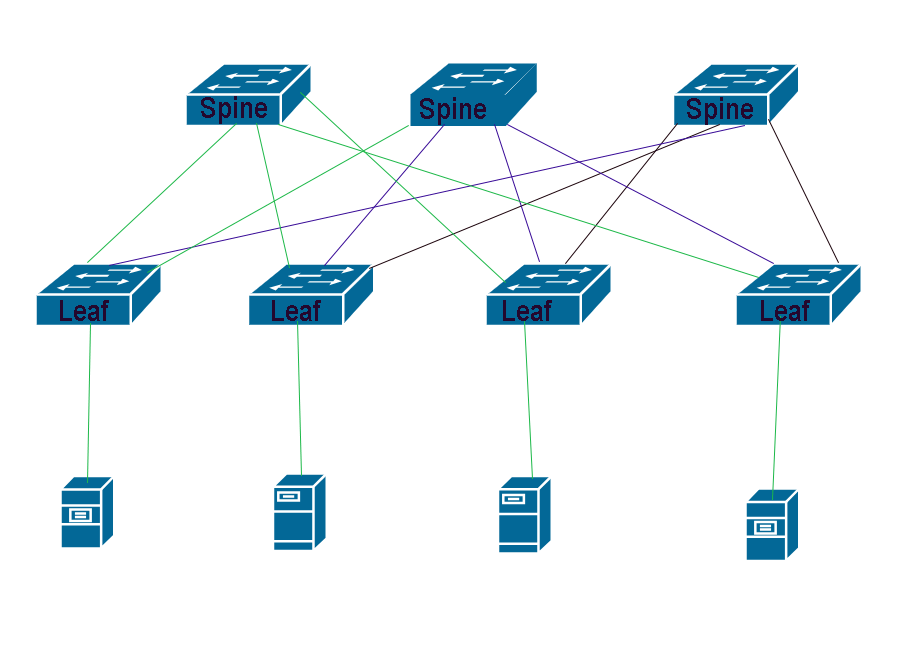
Key points:-
- Only leaf switches can connect to end devices.
- A leaf switch cannot connect to another leaf switch directly.
- A leaf switch can only connect to a spine switch.
- A spine switch cannot connect to another spine switch.
- A spine switch can connect only to a leaf switch.
- A spine switch cannot connect to any end device.
- Each spine switch must connect to every leaf switch.
- Each leaf switch must connect to every spine switch.
- It uses IP routing on all links.
- It provides horizontal scaling.
- It does not use STP (Spanning Tree Protocol).
Advantages of spine-leaf
- It requires fewer switches than the traditional three-tier architecture.
- It provides more bandwidth and speed.
- Data always follows a predictable path.
- All devices are always available within two hops.
Disadvantages of spine-leaf
- It requires more Ethernet cables than traditional three-tier architecture.
- The maximum number of leaf switches you can connect to a spine switch is limited by its ports. For example, if a spine switch has 8 ports, it can connect 8 leaf switches.
- It requires full mesh connections between spine and leaf switches, which is hard to create and manage.
This tutorial is part of the tutorial series 'Describe characteristics of network topology architectures'. The other parts of this tutorial series are as follows.
Chapter 1.2.a & b 2 Tier and 3 Tier Architecture in Networking
Chapter 1.2.c Spine-Leaf Architecture in Computer Networking
Chapter 1.2.d Wide Area Network (WAN) Explained
Chapter 1.2.e Small Office / Home Office Architectures Explained
Chapter 1.2.f On-premises and Cloud Explained
This tutorial series covers the following CCNA Exam v1.1 (CCNA 200-301) topics.
1.0 Network Fundamentals
- 1.2 Describe characteristics of network topology architectures
-
- 1.2.a Two-tier
- 1.2.b Three-tier
- 1.2.c Spine-leaf
- 1.2.d WAN
- 1.2.e Small office/home office (SOHO)
- 1.2.f On-premises and cloud
Conclusion
Spine-leaf is a new network architecture. It classifies network switches into two types: spine and leaf. Spine switches connect leaf switches. Leaf switches connect end devices. Each spine switch connects every leaf switch and vice versa. Switches in the same layer cannot have a direct connection. For example, a spine switch cannot directly connect to another spine switch. Similarly, a leaf switch cannot directly connect to another leaf switch. These restrictions and standards make this architecture predictable.
Author Laxmi Goswami Updated on 2026-08-10