Wide Area Network (WAN) Explained
WAN stands for Wide Area Network. It is an architecture that defines and standardizes a computer network that spans across a large geographic area. To connect network segments (also known as LANs), it uses broadband connections, leased lines, dedicated circuits, and many other packet-switching services. This tutorial explains its features and functions.
WAN topologies
A WAN topology defines the layout you use to connect the remote sites of a network. There are three types of WAN topologies:-
- Point-to-Point topology
- Hub-and-Spoke topology
- Mesh topology
Point-to-Point topology
In this topology, two sites connect through a dedicated continuous link. The link always remains available and ready for data transfer. It allows sites to exchange data immediately without a delay caused by the connection initiation and authentication process. Since the two sites connect directly, there is no place for hackers to intercept data exchanged and transferred by both sites.
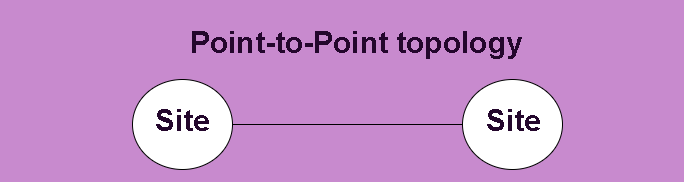
Cost and low scalability are the negative points of this topology. A dedicated line is the most expensive WAN solution. It is charged for all the time, whether you use it or not. In addition, it connects only two sites. If you want to add a new site, you must purchase a new dedicated line, which makes it less scalable.
Hub-and-Spoke topology
In this topology, remote branch sites (called spokes) connect to a central site (called a hub). Branches have no direct connections. They connect through the central site. Since all network traffic goes through the central site, you can deploy centralized security policies and business logic there.
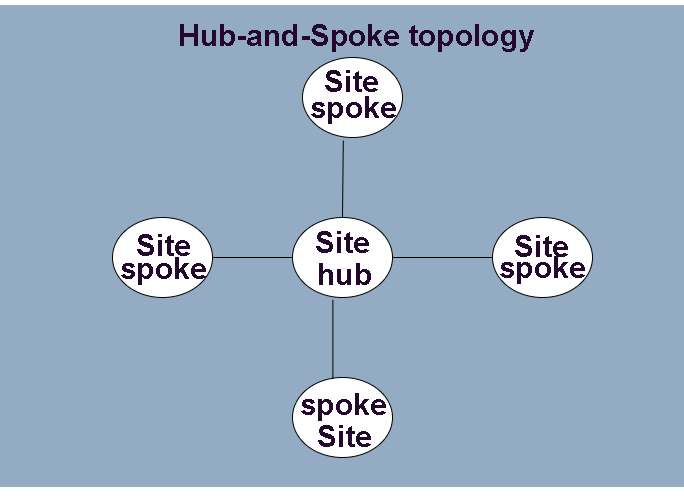
On the positive side, it provides a centralized management interface for monitoring and controlling network traffic and implementing security policies. On the negative side, if the core hub fails, it can bring the entire network down. Since branch sites have no direct connections, they cannot communicate with each other if the central hub fails.
Mesh topology
In this topology, all sites have direct connections to each other. It provides the highest level of fault tolerance and redundancy. However, it requires many direct connections, which significantly increases network cost. In addition, managing these is also challenging. You need to monitor and regulate each connection independently.
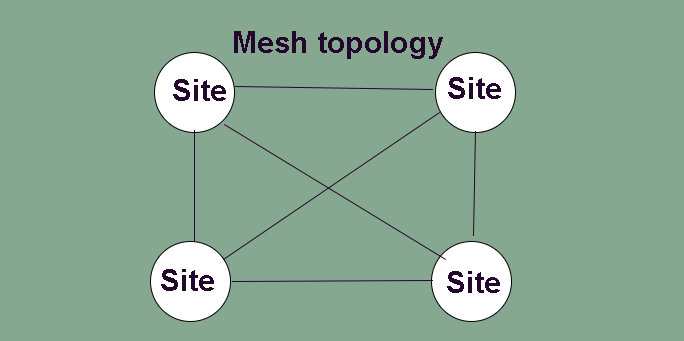
To reduce connection cost and simplify management, you can skip direct connections between non-critical sites. This setup is called a partial mesh. The difference between a partial and full mesh is that in a full mesh, all sites have direct connections, whereas in a partial mesh, only critical sites have direct connections.
Software-Defined WAN (SD-WAN)
SD-WAN was introduced a few years back. Since its launch, it has gained popularity. It has become the de facto standard in modern networking. It creates a virtualized architecture over the existing physical network designs and uses that to transport, manage, and control network traffic. Since software applications manage the network traffic, you can easily re-route it, implement security policies, and update business logic. These features make it highly flexible and scalable.
WAN components
A WAN network deploys and uses various components to transmit data across the different sites. The key components are the following.
Routers
A router connects different IP subnets. It maintains a list of all connected IP subnets in the routing table. When it receives a data packet, it finds the packet’s destination address in the routing table. If the routing table has an entry for the destination address, it forwards the packet from the interface specified in the entry. If not, it discards the packet. In a WAN implementation, different sites use different IP subnets. To connect these sites, routers are placed between them.
Switches
A switch connects end devices in a local network. Each end device has a unique MAC address. A swtich maintains a list of MAC addresses of all connected devices in the CAM table. When it receives a frame, it finds the frame’s destination address in the CAM table. If the CAM table has an entry for the destination address, it forwards the frame from the port specified in the entry. If not, it forwards the frame from all ports except the incoming port. In a WAN implementation, sites use switches to connect end devices.
Modems
Carriers that connect different sites use various methods and technologies to transport data. A modem modulates and demodulates signals, allowing them to be transmitted over different media types.
Connection lines
Connection lines are the cables between different geographical sites. Many companies' data carrier companies provide these lines on a subscription basis.
Firewall
A firewall monitors and filters traffic to block unauthorized access to the network. It is available in two variations: software and hardware. Hardware firewalls are integrated devices. They are expensive but provide more control and security.
VPN
VPN (Virtual Private Network) creates a secure private network over an insecure public network such as the Internet.
Key points:-
- It connects networks located in different geographical locations.
- It uses various security appliances to transfer data between sites securely.
- It uses many topologies and architectures. Point-to-point, hub-and-spoke, and mesh are the most widely used topologies.
- It uses many connection types to connect different sites. Lease lines, ATM, and ISDN are a few examples of the connection types.
- Internet is the largest WAN network.
This tutorial is part of the tutorial series 'Describe characteristics of network topology architectures'. The other parts of this tutorial series are as follows.
Chapter 1.2.a & b 2 Tier and 3 Tier Architecture in Networking
Chapter 1.2.c Spine-Leaf Architecture in Computer Networking
Chapter 1.2.d Wide Area Network (WAN) Explained
Chapter 1.2.e Small Office / Home Office Architectures Explained
Chapter 1.2.f On-premises and Cloud Explained
This tutorial series covers the following CCNA Exam v1.1 (CCNA 200-301) topics.
1.0 Network Fundamentals
- 1.2 Describe characteristics of network topology architectures
-
- 1.2.a Two-tier
- 1.2.b Three-tier
- 1.2.c Spine-leaf
- 1.2.d WAN
- 1.2.e Small office/home office (SOHO)
- 1.2.f On-premises and cloud
Conclusion
There are many network types. WAN is one of them. It covers the largest geographical area. In this tutorial, I explained the features, functions, and key components of the WAN network.
Author Laxmi Goswami Updated on 2026-08-10