Controllers in Computer Networks Explained
A network controller controls, monitors, and manages network traffic and devices for you. It works between you and your network. You tell it how the network should function or what objectives it should deliver. It then configures and optimizes the network devices to meet those objectives. It was originally developed as a software program. Nowadays, it is also available as a hardware device. Hardware controllers are expensive but provide more scalability, speed, and stability than software controllers. No matter whether you use a hardware or a software controller, both are built with the same logic and provide the same features and functions at the core level.
Roles and functions of network controllers
A network controller works as an assistant. It takes your instructions and applies them to the network. You define your network logic and requirements. It monitors and manages network devices and configurations as per your instructions.
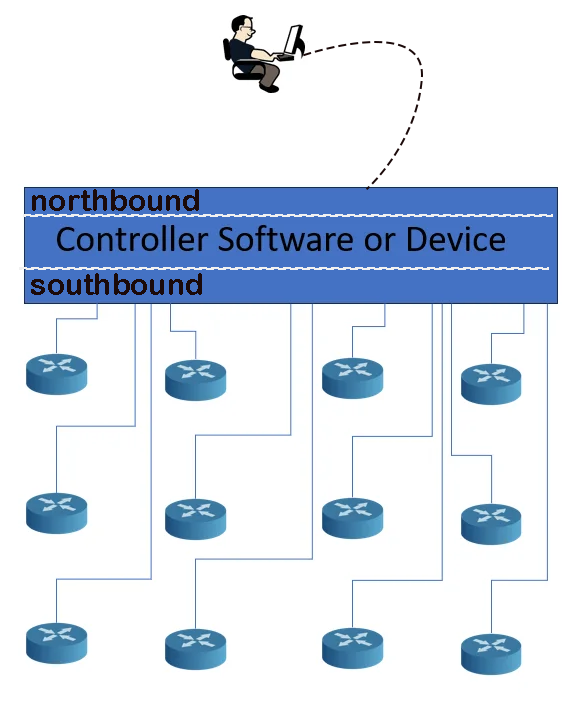
Technically, it consists of two types of APIs: northbound and southbound. The northbound api provides a platform for you to enter your business logic. It allows you to define the desired network settings and services. The southbound api configures and controls network devices and services based on the configurations and settings defined in northbound.
The main functions of a network controller are the following.
- It automatically discovers all network devices, builds a virtual map of the network layout or topology, and uses it to monitor the network status.
- It continuously monitors the software and applications running on network devices for updates and vulnerabilities. If there is an update or security fix release for any running application or software, it automatically downloads and installs that on the device running that application or software.
- It integrates with the configured reporting systems on the network and informs them of real-time updates and the status of the network devices.
- It provides a centralized management system for managing all network devices from a central location.
- It continuously analyzes network traffic to detect potential performance issues. If it detects any issue, it also offers a possible solution.
- It automatically performs routing maintenance tasks.
Example
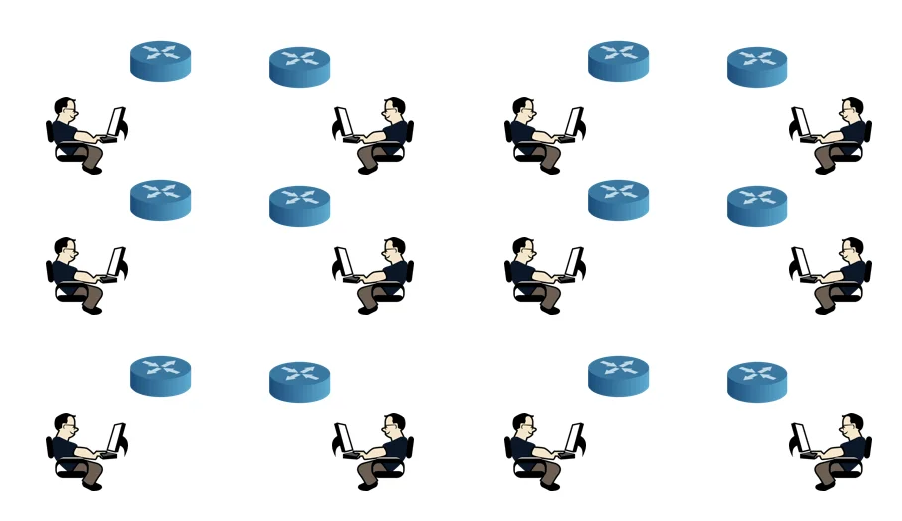
The following image shows a traditional network. It contains many routers. The administrator needs to manage all routers individually.
The following image shows the same network with a network controller. The administrator configures the controller. The controller manages all routers for him.
Advantages of network controllers
A network controller provides the following advantages.
- It reduces network management costs by providing a centralized management system.
- It reduces errors by automating configurations.
- It provides scalability and streamlines management.
- It ensures network services remain always available.
- It provides flexibility and improves response time.
- It improves network security and ensures data integrity.
Types of network controllers
| SDN Controller (Software-Defined Networking Controller) | It works in an SDN architecture. It separates the management plane from the data plane. |
| Network Interface Controller (NIC) | It is a physical device. It is installed on a computer or a network device and connects it to a wired network. It translates binary data into electric signals and vice versa. It is also known as a LAN card or an Ethernet card. |
| WLAN Controller (Wireless LAN Controller) | A wireless LAN card is similar to a LAN card. The only difference between the two is that it translates binary data into radio signals and vice versa. It connects the device to a wireless network. |
| Switch Controller | It configures, manages, and monitors network switches. It ensures all network switches function properly and within the defined network policies. |
| Network Traffic Controller | It controls, manages, classifies, and analyzes network traffic. It reduces network congestion and improves network performance. Load balancing, traffic scheduling, policy-based management, and congestion control are core features of it. |
| Bandwidth Controller | It controls and manages network bandwidth. It allocates fair bandwidth to each network device and monitors that allocation. It does not allow devices to use more bandwidth than the allocated bandwidth. It ensures a fair portion of network bandwidth always remains available for critical network devices and applications. |
| Open-Source Network Controller | It is based on open standards. It offers a flexible and affordable solution for managing wireless LAN infrastructure. |
This tutorial is part of the tutorial series 'Role and function of network components'. The other parts of this tutorial series are as follows.
Chapter 1.1.a Routers in Computer Networks Explained
Chapter 1.1.b Layer 2 and Layer 3 Switches Explained
Chapter 1.1.c Next-generation firewalls and IPS Explained
Chapter 1.1.d Access Points in Computer Networks Explained
Chapter 1.1.e Controllers in Computer Networks Explained
Chapter 1.1.f Endpoints in Computer Networks Explained
Chapter 1.1.g Servers in Computer Networks Explained
Chapter 1.1.h PoE in Computer Networks Explained
This tutorial series covers the following CCNA Exam v1.1 (CCNA 200-301) topics.
1.0 Network Fundamentals
- 1.1 Explain the role and function of network components
-
- 1.1.a Routers
- 1.1.b Layer 2 and Layer 3 switches
- 1.1.c Next-generation firewalls and IPS
- 1.1.d Access points
- 1.1.e Controllers
- 1.1.f Endpoints
- 1.1.g Servers
- 1.1.h PoE
Conclusion
Network controllers are key elements of modern networks. They simplify administration, reduce costs and errors, and provide the flexibility needed to adapt to evolving business needs. They centralize control, automating key tasks and boosting scalability, security, and capability. In this tutorial, I explained their types,features, functions, and the roles they play in modern networks.
Author Laxmi Goswami Updated on 2026-07-29