Endpoints in Computer Networks Explained
An endpoint is a device that connects to a computer network. It works as an endpoint for a communication process. If two computers connect on a network and exchange data, they are both called endpoints. However, any devices that provide connectivity between these devices are not endpoints. An endpoint must sit at the end of the communication process.
Let’s take an example. You make a phone call to your friend. Your friend picks up the call, and you talk with him. In this example, your and your friend’s phones are the end devices. Any devices that enable this communication are the intermediate devices. Mobile towers, routers, switches, and firewalls are examples of intermediate devices.
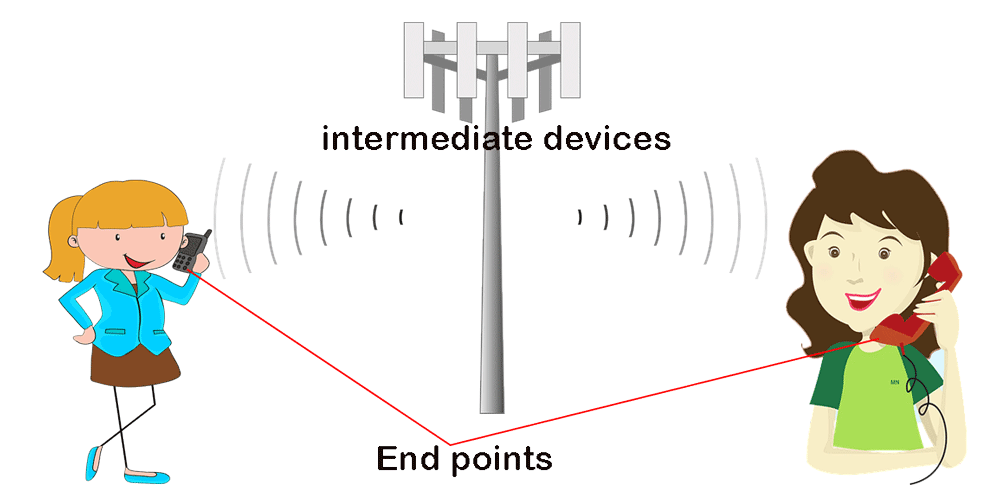
Similarly, the device (smartphone, laptop, or a computer) you are using right now to read this tutorial is an example of an end device.
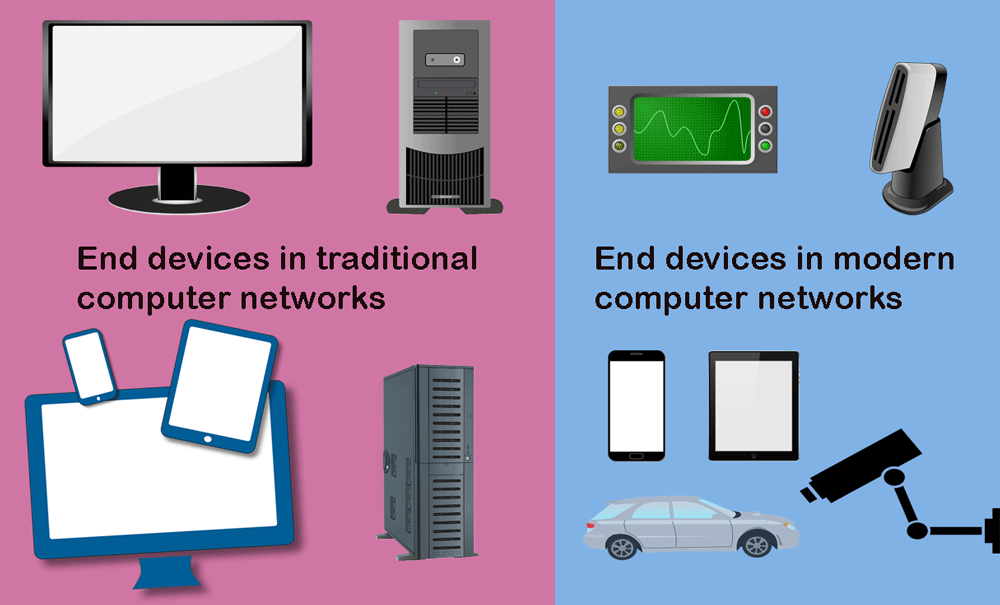
In traditional computer networks, endpoints were simple user devices such as PCs, laptops, and servers. In modern networks, many other types of end devices have emerged. These devices enable modern networks to utilize the latest technology evolution and expand them beyond the boundaries of traditional networks. The following table lists the types of end devices used in modern networks.
| User devices | These devices are generally used to perform common tasks such as running applications and accessing services running on remote devices. PCs, smartphones, laptops, tablets, and desktop computers are examples of user devices. |
| Server devices | These devices are commonly used to run various services, such as web and file-sharing services. These devices run the applications the user devices access. Servers, clouds, and VPSs are examples of server devices. |
| Operational devices | These devices manage physical processes and control data acquisition. These devices utilize the most advanced technologies and infrastructures. |
| Internet of Things | These devices expand standard computer networks. They connect non-standard devices to the network. Security cameras, medical devices, transport devices, and scientific equipment are examples of IoT (Internet of Things). |
Any devices that do not terminate a communication path or sit in the middle of it are not end devices. These devices are commonly referred to as networking devices. CPE (customer premises equipment), routers, switches, network gateways, firewalls, and load balancers are examples of networking devices.
Roles and functions of end devices in a computer network
End devices provide the following functions in a computer network.
- They start and end a session. In a session, they access and provide services and data.
- They provide a platform to access services running on a network.
- They translate electrical signals into human-readable data and vice versa.
- They allow you to exchange data between two devices.
- They enable communications between two sites connected with a network.
This tutorial is part of the tutorial series 'Role and function of network components'. The other parts of this tutorial series are as follows.
Chapter 1.1.a Routers in Computer Networks Explained
Chapter 1.1.b Layer 2 and Layer 3 Switches Explained
Chapter 1.1.c Next-generation firewalls and IPS Explained
Chapter 1.1.d Access Points in Computer Networks Explained
Chapter 1.1.e Controllers in Computer Networks Explained
Chapter 1.1.f Endpoints in Computer Networks Explained
Chapter 1.1.g Servers in Computer Networks Explained
Chapter 1.1.h PoE in Computer Networks Explained
This tutorial series covers the following CCNA Exam v1.1 (CCNA 200-301) topics.
1.0 Network Fundamentals
- 1.1 Explain the role and function of network components
-
- 1.1.a Routers
- 1.1.b Layer 2 and Layer 3 switches
- 1.1.c Next-generation firewalls and IPS
- 1.1.d Access points
- 1.1.e Controllers
- 1.1.f Endpoints
- 1.1.g Servers
- 1.1.h PoE
Conclusion
In this tutorial, I explained the definitions, features, and functions of end devices in traditional and modern networks. In traditional networks, end devices were simple physical devices such as computers, laptops, printers, phones, and tablets. In modern networks, the definition of endpoints has expanded to include Internet of Things (IoT) devices (such as security cameras, ID card readers, and self-driving vehicles) and web-based services and devices (such as cloud services, virtual servers, and web-based applications).
Author Laxmi Goswami Updated on 2026-07-29